The Causeway's story began during the Thulean Volcanism. Massive fissures opened in the Earth, spewing molten basalt. As the lava settled in a deep pool and cooled, it contracted vertically. Much like drying mud, it cracked into the symmetrical, six-sided columns we see today, creating a geological ‘pavement’ that defies belief.
History of the Giant's Causeway | Ancient geology meets epic legend
Forged by the fiery breath of the earth 60 million years ago, the Giant's Causeway is a geological masterpiece of 40,000 interlocking basalt columns. While it looks like a meticulously paved road for titans, this UNESCO World Heritage site is actually the result of rapid volcanic cooling. Best of all? It’s a natural wonder you can climb freely, no climbing gear required!
Giant's Causeway history timeline
- 60 million years ago: Volcanic activity
The Paleogene Period sees intense volcanic eruptions creating the Antrim plateau. - 50-60 million years ago: Column formation
Molten basalt cools rapidly, contracting into the iconic hexagonal pillars. - 15,000 years ago: The last Ice Age
Glacial erosion strips away surface rock, revealing the hidden causeway beneath. - 3rd century AD: The legend of Finn McCool
Oral traditions begin describing the causeway as a bridge built by the giant Finn McCool. - 1588: The Girona shipwreck
The Spanish Armada ship Girona sinks off the Causeway Coast during a storm. - 1692: Academic discovery
Sir Richard Bulkeley of Trinity College, Dublin, presents the first paper on the site. - 1740: Susanna Drury’s gouaches
Watercolours of the site bring international fame, attracting Europe’s ‘Grand Tourists’. - 1883: Giant’s Causeway tramway
The world's first hydro-electric tramway opens, revolutionising tourism to the site. - 1986: UNESCO recognition
The site is declared a UNESCO World Heritage site for its geological importance. - 2012: New visitor centre
The National Trust opens an award-winning, sustainable visitor centre to manage global crowds.
Giant's Causeway history explained
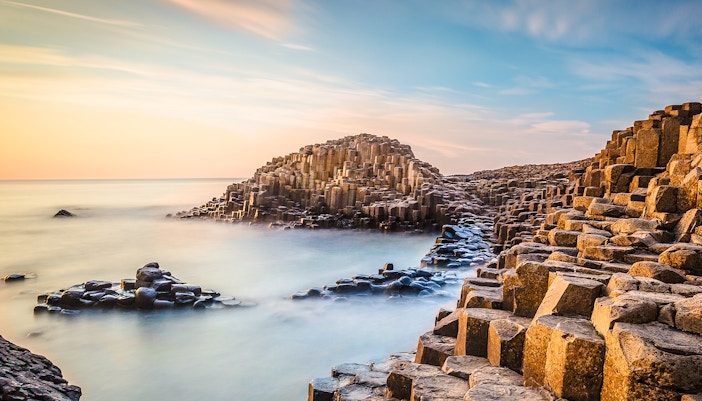
The volcanic birth (60 million years ago)
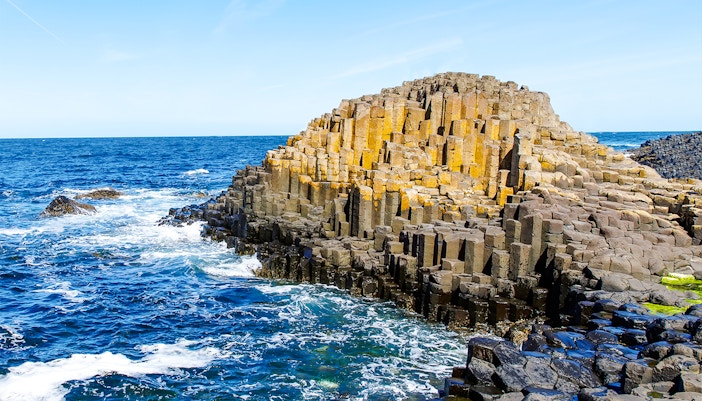
The battle of the giants (Folklore)
Legend tells a different story. The Irish giant Finn McCool built the causeway to reach Scotland and fight his rival, Benandonner. Upon seeing the Scot's massive size, Finn disguised himself as a baby. Terrified that the ‘infant’s’ father must be truly gargantuan, Benandonner fled back to Scotland, ripping up the bridge behind him.
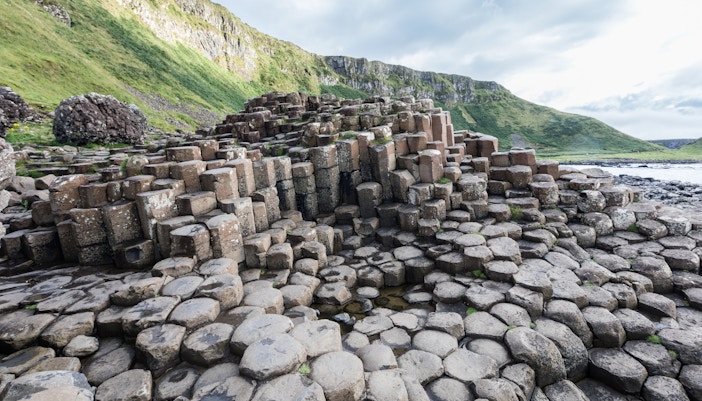
The era of discovery (17th–19th century)
For centuries, the Causeway was a local secret until the late 1600s. The debate over whether it was man-made or natural raged in scientific circles for decades. By the 1800s, it became a cornerstone of the ‘Romantic’ travel era, with Victorian tourists flocking to see the ‘eighth wonder of the world’ via the innovative electric tramway.
Giant's Causeway today - Why it matters
Today, the Giant’s Causeway is Northern Ireland’s only UNESCO World Heritage site and a crown jewel of the National Trust. It serves as a vital laboratory for geologists and a sanctuary for rare flora and fauna, such as the stromatolite-like formations in the rock pools. Visitors can hike the Red Trail for bird's-eye views or stand on the Honeycomb to feel the raw power of the Atlantic.
Frequently asked questions about Giant’s Causeway history
They were formed by the rapid cooling of basaltic lava. As it cooled, it contracted into mostly hexagonal shapes—a process known as columnar jointing.
Yes! Fingal’s Cave on the island of Staffa features the same basalt columns, which is why the legend says the bridge connected the two countries.
It is a unique rock formation on the shore that resembles a massive petrified boot, said to have been lost by Finn McCool as he fled the coast.
It was designated in 1986 because of its unique geological features and its importance to the study of the Earth’s history.


